Milford Sound Guide: Getting There, Cruises and What's Changing
Milford Sound / Piopiotahi is a fiord in Fiordland National Park, about 120 km and 2 to 2.5 hours non-stop from Te Anau, or about 290 km and 4.5 hours from Queenstown. Most people drive or take a coach in, do a cruise of 1 hour 45 minutes to 2 hours 15 minutes from about NZ$180 and head back the same day, which makes a day of 12 hours or more from Queenstown. International visitors may also face a new access charge from summer 2027/28 at the earliest, but the bill lapsed when Parliament dissolved for the election and no rate has been set.
Milford is a long detour from everywhere else, so give it its own slot. Our South Island itinerary shows where it fits on 7, 10 and 14 day routes. Below are the three decisions in order, then the access charge most guides haven't caught up with.
How do you get to Milford Sound?
State Highway 94 from Te Anau is the only road in (NZTA). You can drive it yourself, ride a coach, fly in from Queenstown or walk in on the Milford Track.
| Option | Starts from | Time | Cost from | Good for |
|---|---|---|---|---|
| Self-drive | Queenstown or Te Anau | About 4.5 hours each way from Queenstown, 2 to 2.5 hours from Te Anau | Fuel, plus a cruise from about NZ$180 | Early starts and stopping where you like |
| Coach and cruise | Queenstown or Te Anau | About 12 hours from Queenstown | From about NZ$300 | Not driving the Milford Road yourself |
| Fly-cruise-fly | Queenstown | 4 to 5 hours return | About NZ$765 | Short on time, clear weather |
| Milford Track | Te Anau Downs | 4 days, 3 nights | NZ$152 a hut night for international adults | Trampers who booked months ahead |
Driving yourself
The Milford Road runs about 120 km from Te Anau and takes 2 to 2.5 hours without stops (DOC). From Queenstown it's about 290 km each way, which NZTA rounds to 300 km and four to five hours (NZTA). DOC puts Queenstown to Milford at about 4.5 hours each way, a nine-hour return drive before you add a cruise (DOC journey tips).
Driving lets you leave at dawn and beat the coaches. The road climbs to 940 m and squeezes through the one-lane Homer Tunnel. The stops and the day trip versus Te Anau decision are in Queenstown to Milford Sound: Day Trip or Te Anau.
Coach and cruise
RealNZ's day trip leaves Queenstown at 6.45am, 6.55am or 7.35am. It's about 5 hours each way on the coach with a break in Te Anau, plus a 1.5 to 2 hour cruise, from NZ$319 (RealNZ). Mitre Peak Cruises lists a Queenstown coach and cruise from NZ$410 (Mitre Peak Cruises). Cruise Milford's day tours start from NZ$299 (Cruise Milford).
Take a coach if mountain roads or winter driving worry you. The price is a long day in a seat and arriving around midday with everyone else.
Scenic flight
RealNZ's fly-cruise-fly takes about 45 minutes each way from Queenstown and 4 to 5 hours in total, from NZ$764 (RealNZ). Air Milford's version starts from NZ$795 for adults plus a temporary NZ$59 fuel surcharge (Air Milford). Flights depend on the weather, so book near the start of your Queenstown stay to leave spare days.
Walking in on the Milford Track
The Milford Track is a one-way Great Walk of about 53.5 km over four days and three nights. Great Walks are DOC's premier multi-day tramps, and tramping is the Kiwi word for hiking. A bus and boat take you from Te Anau to the start at Glade Wharf. You sleep at Clinton, Mintaro and Dumpling huts and finish at Sandfly Point, a 20 minute boat ride from Milford Sound (DOC Milford Track).
The 2026/27 season runs from 1 November 2026 to 30 April 2027. A hut night costs NZ$152 for an international adult and NZ$106 for a New Zealand adult. Milford Track bookings opened on 13 May 2026 and the season sold out in 34 minutes, so DOC's advice to book well in advance is no exaggeration. If you missed out, watch for cancellations or look at a guided walk.
Which Milford Sound cruise should you book?
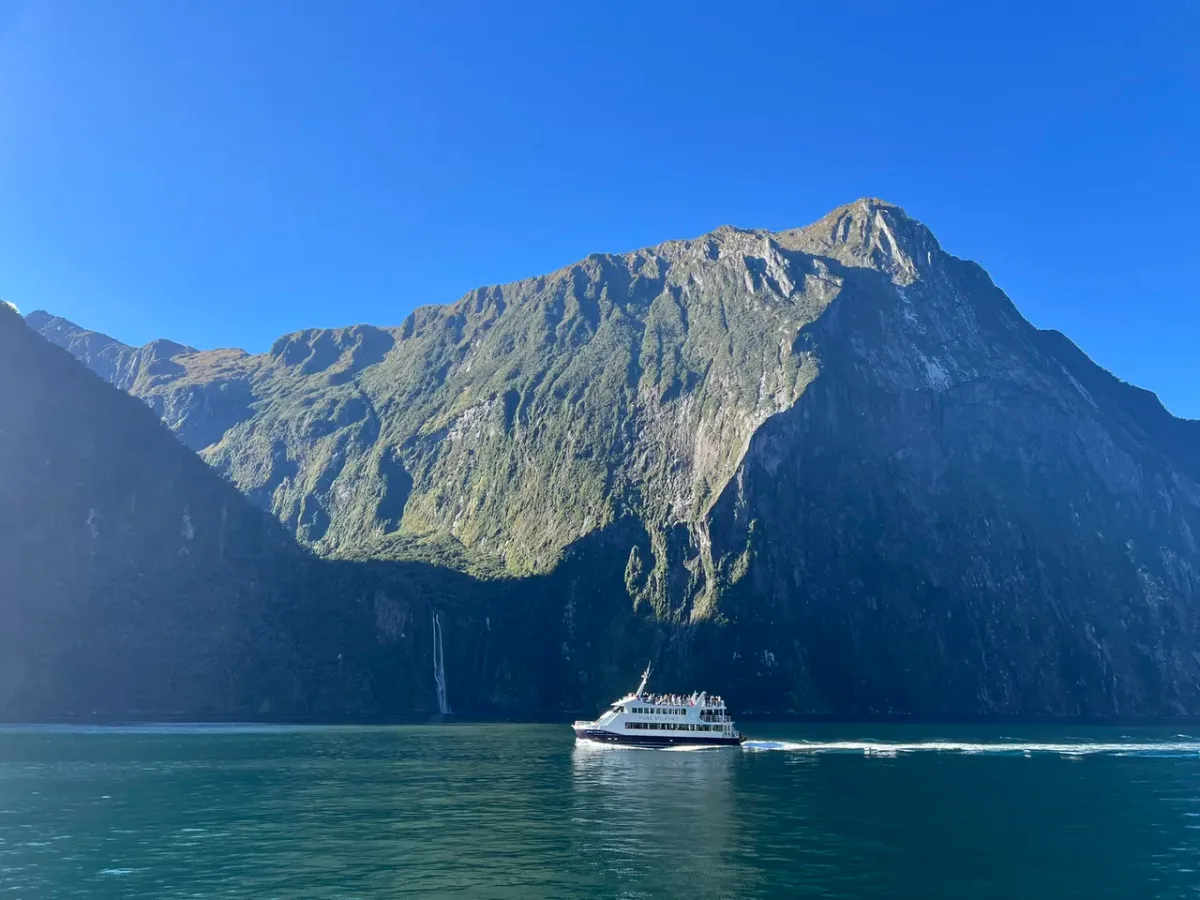
A standard day cruise of about 2 hours is enough for most people. They cover much the same water: Mitre Peak, Lady Bowen and Stirling falls, Seal Rock and the Tasman Sea when the weather allows (RealNZ). Prices sit in a tight band, so the real choices are boat size and time of day.
| Operator | Cruise | Length | Boat | From about |
|---|---|---|---|---|
| RealNZ | Signature Cruise | Up to 2 hours | The Haven (up to 180) or The Mariner (up to 120) | NZ$199 |
| Southern Discoveries | Nature Cruise | 1 hour 45 minutes | Check when booking | NZ$179 |
| Southern Discoveries | Discover More Cruise | 2 hours 15 minutes | Check when booking | NZ$199 |
| Mitre Peak Cruises | Cruise only | 2 hours | Small boats, up to 75 passengers | NZ$179 |
| Cruise Milford | Boutique Small Boat Cruise | 1 hour 45 minutes | Small boat sold to half capacity | NZ$189 |
| RealNZ | Overnight Cruise | 4pm to 9.15am next day | Milford Mariner, sleeps 64 | NZ$799 |
Prices are from operator websites on 9 November 2026.
Big boat or small boat?
RealNZ's The Haven carries up to 180 people, with a rooftop deck and an indoor lounge. Mitre Peak Cruises caps its boats at 75 passengers and builds them to get close to the shoreline. Small boats cost no more here, so pick one if open-deck space and close-up waterfalls matter. A big boat with a warm cabin suits kids and anyone who feels the cold.
Morning, midday or afternoon?
Coaches that leave Queenstown around 7am reach the fiord around midday, so midday sailings are the busiest. Fiordland's regional tourism body suggests early morning or late afternoon in summer (Fiordland NZ). From Te Anau, aim for a first sailing such as Southern Discoveries' 9.30am. RealNZ's last Signature Cruise leaves at 3.25pm.
Kayaking
A kayak puts you at water level under walls that rise 1,692 m straight out of the water at Mitre Peak (DOC). Rosco's Milford Kayaks runs guided trips (Rosco's Milford Kayaks):
- Milford Cruiser: 3 hours with 1.5 to 2 hours on the water, from NZ$205, ages 8 and up.
- Stirling Sunriser: 5 hours with 3.5 to 4 hours paddling from Deepwater Basin, from NZ$335, ages 16 and up.
- Paddle n Walk: 5.5 hours combining a paddle with a walk on the end of the Milford Track, from NZ$195, ages 12 and up.
Overnight cruises
RealNZ's overnight cruise leaves the Milford Sound terminal at 4pm and returns at 9.15am the next day on the Milford Mariner, which sleeps 64. A dinner buffet, cooked breakfast and kayaking or a tender boat ride are included, from NZ$799 (RealNZ Overnight Cruise). Kayakers must be at least 10.
It's not cheap, but it replaces a night's accommodation and puts you on the fiord after the day boats leave.
When is the best time to visit Milford Sound?
Any month works. The weather on the day matters more than the season. Our guide to the best time to visit the South Island covers the whole island season by season.
Summer: long days and the biggest crowds
Summer has the longest days and the most people. DOC reported record visitor numbers last December and January (DOC media releases). Traffic lights control the Homer Tunnel over summer peaks and can hold you for up to 20 minutes (DOC Milford Road tips). The paid car park at Milford fills quickly (Southern Discoveries). Go early or go late.
Winter: clear days and avalanche season
Fiordland NZ says winter (June to August) is often the most settled time (Fiordland NZ). The road is the trade-off.
NZTA says avalanche season on the Milford Road usually runs June to October. The risk sits on a 17 km stretch from Falls Creek, above the Hollyford Road junction, to The Chasm on the Milford side of the Homer Tunnel (NZTA avalanche programme). Don't stop in that zone except at the signposted safe stopping areas. DOC notes that Fiordland avalanches can happen from May to November (DOC).
From June to November you may need to carry chains. Driving past a chains-required sign without fitting them can mean a NZ$750 fine (NZTA). The road closes about eight days a year on average, mostly in winter. DOC suggests leaving Te Anau from 9am in winter. Our guide to driving in the South Island covers chains and winter roads.
Rain: go anyway
Milford Sound gets up to 7 m of rain a year (DOC), so you may well see it wet. Don't cancel. Heavy rain sends temporary waterfalls down every cliff, and cruises are only rarely cancelled (Southern Discoveries). Snow on the road and low cloud for flights are what actually spoil a Milford day.
Will you have to pay an entry fee to visit Milford Sound?
Not yet. Today you pay for your cruise, flight or tour, plus parking if you drive. A charge for international visitors is planned, but its timing is now uncertain.
What is the international visitor access charge?
The Conservation Amendment Bill is a wide overhaul of conservation law. One part creates what it calls an "international visitor access levy", payable before entering specified conservation areas. DOC is investigating it at four sites: Milford Sound, Aoraki / Mount Cook, Mautohe / Cathedral Cove and the Tongariro Alpine Crossing (DOC). The money would be ringfenced for conservation and visitor facilities. Early forecasts put it around NZ$60 million a year from the four sites (DOC factsheet).
It would be on top of the NZ$100 International Visitor Conservation and Tourism Levy most visitors already pay with their visa or NZeTA. Australians and citizens of many Pacific countries are exempt.
Who would pay?
Anyone who isn't a New Zealand citizen or ordinarily resident here. DOC describes that as having lived in New Zealand for at least six of the last 12 months (DOC factsheet). DOC has floated exemptions, such as international visitors with a Great Walk booking at a charged site. Nothing is final (DOC implementation factsheet).
How much will it cost?
No rate has been set. Regulations will fix it after the bill passes, and DOC says no decision has been made (DOC implementation factsheet). Three figures have surfaced:
- The bill's regulatory analysis based its revenue estimates on NZ$20 and NZ$40 charges for international visitors (disclosure statement).
- A June 2026 DOC community update lists a NZ$100 international visitor charge among its plans for Milford (DOC presentation).
- The same update cites research putting international visitors' willingness to pay at about NZ$90 to NZ$110, lower for Australians.
Treat NZ$100 as a rough guide. It isn't a confirmed rate. DOC has also discussed day passes and a joint pass with Aoraki / Mount Cook. It could be collected at gates, by tour operators or through parking. Under the bill, entering a charged area without paying would carry a NZ$200 infringement fee.
When could it start?
DOC is aiming for summer 2027/28 and says that may change depending on the bill's progress (DOC implementation factsheet). Its June 2026 update had the system going live from October 2027 (DOC presentation).
That assumed the bill kept moving. On 3 September 2026 the Environment Committee released an interim report with a redrafted bill. DOC said the committee didn't expect to finish before the election and more hearings and changes were likely afterwards (DOC). Parliament was dissolved on 1 October for the 7 November general election (Electoral Commission), and the bill lapsed with it (Parliament). The new Parliament can reinstate it at the stage it had reached. Preliminary results were too close to call, with special votes still to be counted and official results due on 27 November (RNZ). Even if it's reinstated, the bill still needs a select committee report and two more readings, then regulations. You can follow it on the Parliament bills site.
| Date | What happened |
|---|---|
| 15 November 2024 | Government releases a discussion document on charging for access to some conservation land |
| 7 May 2026 | Conservation Amendment Bill introduced |
| 12 May 2026 | First reading, then referred to the Environment Committee |
| June to August 2026 | DOC targeted consultation on charges at the four sites |
| 13 July 2026 | Select committee submissions close after a 10 day extension (Te Ao Māori News) |
| 3 September 2026 | Committee interim report and redrafted bill |
| 1 October 2026 | Parliament dissolved for the election and the bill lapsed |
| 7 November 2026 | General election, official results due 27 November |
| Summer 2027/28 | DOC's target for the first charges, at the earliest |
Our verdict: you won't pay an access charge this summer (2026/27). For 2027/28 or later, leave room in the budget and check again before you book.
What else is changing at Milford Sound?
In June 2025 the Government's first decisions on the Milford Opportunities Project kept cruise ships and scenic flights in the fiord and committed NZ$15.2 million to upgrades, including new short stops on the road (DOC). DOC's June 2026 update lists ideas still being assessed, including paid parking at Deepwater Basin and a park and ride east of the Homer Tunnel (DOC presentation).
For now, Southern Discoveries lists the public car park at NZ$10 an hour, a 10 to 15 minute walk from the cruise terminal. Deepwater Basin has free parking and a shuttle with no fixed timetable, so allow up to an hour (Southern Discoveries).
Practical tips: fuel, sandflies, food, toilets and phone signal
Fuel
Fill up in Te Anau. DOC says there are no shops or fuel stations between Te Anau and Milford Sound (DOC Milford Road tips). Milford has a small Allied fuel stop with card-only pumps (Milford Lodge). Treat it as emergency fuel and don't bet the drive back on it.
Sandflies
Milford's sandflies are relentless. Southern Discoveries tells passengers to wear long sleeves and long trousers and bring repellent (Southern Discoveries). Put it on before you open the car door.
Food and toilets
There are no shops on the road. Milford has a cafe by the main car park and a restaurant at Milford Lodge, and some boats sell food. A packed lunch from Te Anau is cheaper and usually better. Public toilets on the road are only at Te Anau, Knobs Flat (about 65 km in) and Milford (DOC Milford Road tips).
Phone signal
Don't count on it. DOC says reception is limited on the Milford Road but available at Te Anau Downs, Totara Campsite, The Divide and Milford Sound itself (DOC). The Milford site is shared by One NZ, Spark and 2degrees through the Rural Connectivity Group, but treat signal at the terminal as a bonus. The Homer Tunnel has an emergency-only satellite phone. Our South Island mobile coverage guide covers which networks reach where.
So do your planning in Te Anau while you still have reliable signal: tonight's dinner, tomorrow's fuel and a bed for after the drive back. Kiwi Guide helps you find cheap places to eat, fuel and places to stay near where you are, so run that search over breakfast before you head north.
Frequently asked questions
Is Milford Sound worth it in the rain?
Yes. Heavy rain sends temporary waterfalls down the cliffs all around the fiord, and Fiordland NZ says the falls are at their best on wet days. Milford gets up to 7 m of rain a year and cruises are only rarely cancelled.
How long is a Milford Sound cruise?
Day cruises run from about 1 hour 45 minutes to 2 hours 15 minutes and cost from about NZ$180 to NZ$200 for an adult, including small-boat cruises. RealNZ's overnight cruise leaves at 4pm and returns at 9.15am the next day, from NZ$799.
Do I need to book a Milford Sound cruise in advance?
Book before you drive in, especially in summer, so you're not relying on spare seats after a 2 hour drive from Te Anau. Milford Track huts must be booked well in advance for the Great Walks season, which runs from 1 November 2026 to 30 April 2027.
Will I have to pay an entry fee for Milford Sound?
Not in summer 2026/27. The Conservation Amendment Bill would let the Government charge international visitors for access to Milford Sound and three other sites, but it lapsed when Parliament dissolved for the election and no rate is set. DOC is aiming for summer 2027/28 at the earliest. New Zealand citizens and people ordinarily resident here would not pay.
Can I drive to Milford Sound in winter?
Yes. The road closes only about eight days a year on average, mostly in winter. From June to November you may need to carry chains, and passing a chains-required sign without fitting them can mean a NZ$750 fine. Avalanche season usually runs June to October and you can't stop in the avalanche zone near the Homer Tunnel outside the signposted safe areas, so take a coach from Te Anau if you're not confident on snow and ice.
Sort Te Anau before the Milford Road
Find cheap places to eat, fuel and somewhere to stay in Te Anau and across the South Island, near where you are. Kiwi Guide leans towards cheap and cheerful.
Explore Kiwi Guide